If you’ve ever popped the hood of a car (or even just stared at the fluid reservoir behind the brake booster, let’s be real), you’ve probably glanced at that plastic, half-translucent tank sitting right on top of the brake master cylinder. I get it—most people write it off as just a “fluid holder,” like a water bottle for your coffee. But as a brake master cylinder supplier, I’m here to tell you it’s way more than that. Skimp on understanding its role, and you’re not just ignoring a part—you’re risking a brake job (or worse) going sideways fast. Let’s break this down like we’re chatting over a coffee at a parts counter, no jargon that makes your eyes glaze over. Brake Master Cylinder
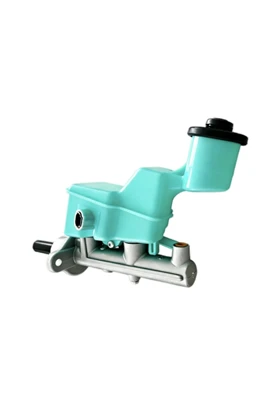
First, let’s set the stage: the brake master cylinder is the heart of your car’s hydraulic brake system. When you mash the brake pedal, you’re pushing a plunger inside the master cylinder, which squeezes brake fluid into the lines running to your wheels. That fluid transfers force (way more efficiently than pushing rods or cables) to the calipers or wheel cylinders, which squeeze the rotors or drums to stop the car. But here’s the thing: hydraulic systems hate air bubbles, and they hate hot, expanding fluid. That’s where the reservoir comes in—though it does way more than just hold extra fluid.
Let’s start with the most obvious job: it stores extra brake fluid, but not just any extra. Over time, brake fluid absorbs moisture like a sponge. That’s why you should flush your brake fluid every 2-3 years, right? The reservoir keeps a reserve so that even a tiny bit of fluid leaks out (micro-leaks are super common, even in new master cylinders) or evaporates a little, you don’t run dry mid-brake stop. Wait, why would you lose fluid? Oh, if your brake pads wear down, the caliper pistons push out a little to fill the gap between the pad and rotor—they take that extra fluid from the reservoir. If the reservoir didn’t have extra, you’d have to push the pedal further to get the same stopping power, and eventually, you’d push the plunger too far and suck air into the lines. That’s a spongy brake pedal, and trust me, that’s the stuff of nightmares. No one wants to mash the brake and feel like they’re pressing a soft pillow while approaching a stop sign.
Next up: handling fluid expansion, which is a huge one most DIYers miss. Brake fluid doesn’t just sit there—it heats up. A lot. When you’re driving hard, towing a trailer, or even just stopping and going in city traffic, the fluid’s temperature can climb to 500°F or more. Liquid expands when it gets hot, right? If all that expanding fluid had nowhere to go, it would build pressure in the lines, which would push the calipers slightly open, making your brakes drag. That wastes gas, wears out pads and rotors way faster, and can even overheat the system enough to cause brake fade. The reservoir has an open (or semi-open) vent system—no, it’s not just a sealed tank—to let that expanded fluid flow back into it, so pressure stays consistent. I’ve seen so many old master cylinders where the reservoir’s vent got clogged with gunk, and the customer complained of dragging brakes and burning through pads in 10k miles instead of 50k. It’s such a simple fix, but the reservoir’s vent is the unsung hero here.
Speaking of air bubbles: the reservoir is your first line of defense against contamination. Wait, how? Because it’s the only point where the hydraulic system is open to the atmosphere (carefully, not full open, but vented). If you need to bleed your brakes (a regular maintenance task), you hook up bleeder tools to the reservoir or the lines, and you draw fluid (and air) out through the reservoir. But it also has a baffle inside—little plastic ridges that keep fluid sloshing around when you turn, stop hard, or go over a bump. If fluid sloshes away from the inlet to the master cylinder’s plunger, you suck air in. That’s how you get air bubbles in the lines, which are compressible—so when you press the pedal, you’re squeezing air instead of pushing fluid, leading to that spongy pedal I mentioned earlier. The baffle in the reservoir prevents that, even during aggressive driving. I remember a few years back, a customer sent a bunch of master cylinders back because their new reservoirs didn’t have the right baffling—they kept getting air in the system. We quickly adjusted the mold, and that problem went away. It’s the tiny details that make a part work right.
Now, let’s talk about the less obvious stuff: monitoring fluid level. Most reservoirs have that “MIN” and “MAX” line, right? If the fluid drops below MIN, that’s a red flag. It could mean you have a leak in the lines, a bad caliper seal, or that your pads are worn down. The reservoir lets you check that without taking anything apart—just pop the hood, look through the translucent plastic (most are, some are colored so you don’t have to squint). As a supplier, we make sure our reservoirs are made from durable plastic that doesn’t yellow or get cloudy over time—because if you can’t see the fluid level, what’s the point? I’ve had customers tell me they bought cheap master cylinders where the reservoir turned yellow in a year, and they had no idea their brake fluid was low until their pedal went all the way to the floor. That’s a safety issue, not just a quality issue.
Wait, let’s clear up a myth I hear all the time: some people think the reservoir is separate from the master cylinder, but no—most modern master cylinders have the reservoir integrated, either bolted right on top or molded as part of the housing. Some older cars have a remote reservoir, connected by a rubber hose, but even then, that reservoir is doing the same exact jobs. The remote ones were more common in performance cars, where there’s not much space under the hood, but they still have baffles and vent systems. I worked with a road racing team last year—they needed custom reservoirs for their brake master cylinders because their cars had so much lateral g-force in turns. We added extra baffles and made the reservoir shape wider to keep fluid flowing to the master cylinder inlet, even when they were pulling 1.5g through a corner. That’s how important the reservoir is for performance driving, not just daily commuting.
Another thing: the reservoir also helps with pressure regulation, in a way. When you press the brake pedal, the plunger in the master cylinder moves, creating pressure to push fluid to the wheels. Once you let off the pedal, the plunger snaps back, and the fluid flows back from the lines into the reservoir to release pressure. If there was no reservoir, where would that fluid go? It would have nowhere to expand into when pressure drops, so you’d have residual pressure all the time, which again causes brake drag. The reservoir acts as a sort of pressure release valve for the system when you’re not braking. It’s not a mechanical valve, but it serves the same purpose—giving the fluid a place to go when pressure isn’t needed.
Let’s get real for a second: not all reservoirs are created equal. As a supplier, I’ve seen the difference between a good reservoir and a cheap one. A good one uses food-grade (well, brake-fluid-grade) plastic that’s resistant to the chemicals in brake fluid—glycol-ether-based fluid is corrosive over time, so cheap plastic will crack, leak, or degrade. A bad reservoir will start seeping fluid within a year, leaving your brake lines low and risking failure. A good reservoir has the right vent size—too small, and fluid can’t expand, leading to drag; too big, and moisture can get in faster, which ruins brake fluid. And don’t forget the seal between the reservoir and the master cylinder—if that seal is bad, fluid leaks out, air gets in, and the whole system fails. I had a customer once who installed a master cylinder from a no-name brand, and the reservoir seal was just a thin rubber ring that crumbled when they tightened the bolts. They ended up stranded on the highway because their brakes went out. That’s why we test every reservoir we make—pressure test it for leaks, check the baffles, make sure the vent is the right size. It’s not just a part; it’s a safety component.
Wait, let’s tie this all together so it’s not just a list of functions. The brake system is a closed hydraulic loop, right? The master cylinder is the pump that creates pressure, the lines are the pipes, the calipers/wheel cylinders are the actuators, and the reservoir is the loop’s “expansion tank and safety net.” It keeps fluid levels consistent, handles expansion and contraction of fluid, keeps air and contamination out, prevents that spongy pedal, lets you check fluid level easily, and even helps with pressure release. Without it, the master cylinder is just a metal block with a plunger—no wonder so many brake jobs go wrong because people ignore this tiny, easy-to-overlook part.
Now, if you’re a mechanic, a car owner, or someone who sources brake master cylinders for your shop, let’s be clear: you don’t want to cut corners on the reservoir. If you’re buying master cylinders from a supplier that skips on reservoir quality, you’re looking at returns, warranty claims, and worst of all, safety issues. As someone who’s been in this game for over a decade, I’ve seen how one small part like the reservoir can make or break a brake system. We don’t just sell master cylinders and reservoirs—we build parts that keep people safe on the road.
If you’re looking for a reliable brake master cylinder supplier, someone who knows every detail of the reservoir’s role and builds parts to match, reach out. We work with independent shops, fleet managers, and auto parts retailers, and we can tailor master cylinders and reservoirs to fit whatever you need—whether it’s a daily commuter car, a performance truck, or a road racing machine. We test every part, stand behind our work, and make sure every reservoir does exactly what it’s supposed to do: keep your brakes working when you need them most.

Now, before you go, let’s recap the key stuff, because it’s easy to forget: the reservoir isn’t a afterthought, it’s critical for brake function, safety, and longevity. It stores fluid, handles expansion, keeps air out, lets you check levels, and prevents so many common brake problems. Next time you pop your hood, give that little reservoir a nod—it’s working harder than you think.
Clutch Slave Cylinder References:
- Automotive Brake Systems: Theory and Service, ASE Education Foundation, 2021
- Brake Fluid and Hydraulic System Performance, SAE International, 2019
- Master Cylinder Design and Component Function, Brake & Front End Magazine, Vol. 38, No. 12, 2020
Ruian Xinyao Automobile Parts Co., Ltd.
With abundant experience, we are one of the most professional brake master cylinder manufacturers and suppliers in China. We warmly welcome you to wholesale bulk advanced brake master cylinder from our factory. If you have any enquiry about cooperation, please feel free to email us.
Address: Xialin Industrial Zone, Tangxia Town, Ruian City,Wenzhou City,Zhejiang Province,China
E-mail: 18969725686@163.com
WebSite: https://www.raxinyao.com/
